August 14, 2026
19 million patients. 2.5 terabytes. Half a country's medical history, gone in one breach.
This week Poland had to deal with what its Deputy PM called “one of the largest data leaks in history.” MyDr, the country’s main digital health platform connecting tens of thousands of clinics, was breached. Attackers claim data on 18.8 million citizens: PESEL numbers (the Polish equivalent of a social security number), phone numbers, appointments, prescriptions. To prove it, they handed journalists the ID number and a list of 25 prescriptions belonging to one of Poland’s most senior politicians.
Officials say the motive wasn’t political. It was money.
Why health data is the most expensive record on the criminal market
A stolen credit card fetches a few dollars and dies the moment you call your bank. A full medical record has been quoted anywhere from $250 to $1,000 on underground markets, because it doesn’t expire:
- It enables medical identity theft and fraudulent insurance claims, the fastest route to cashing out.
- It contains the full identity kit (national ID, contact details, address) needed to open accounts in someone else’s name.
- It contains diagnoses, procedures and prescriptions, which become leverage for blackmail, especially against public figures.
- And critically: you cannot rotate your medical history. You can change a password. You can reissue a card. You cannot take back a diagnosis. The damage is permanent.
The uncomfortable lesson: infrastructure security wasn’t enough
MyDr is a serious organization running a modern cloud platform at national scale, with the security stack that comes with it: managed cloud infrastructure, identity and access controls, network policies, audit logging, monitoring. That is precisely why this matters.
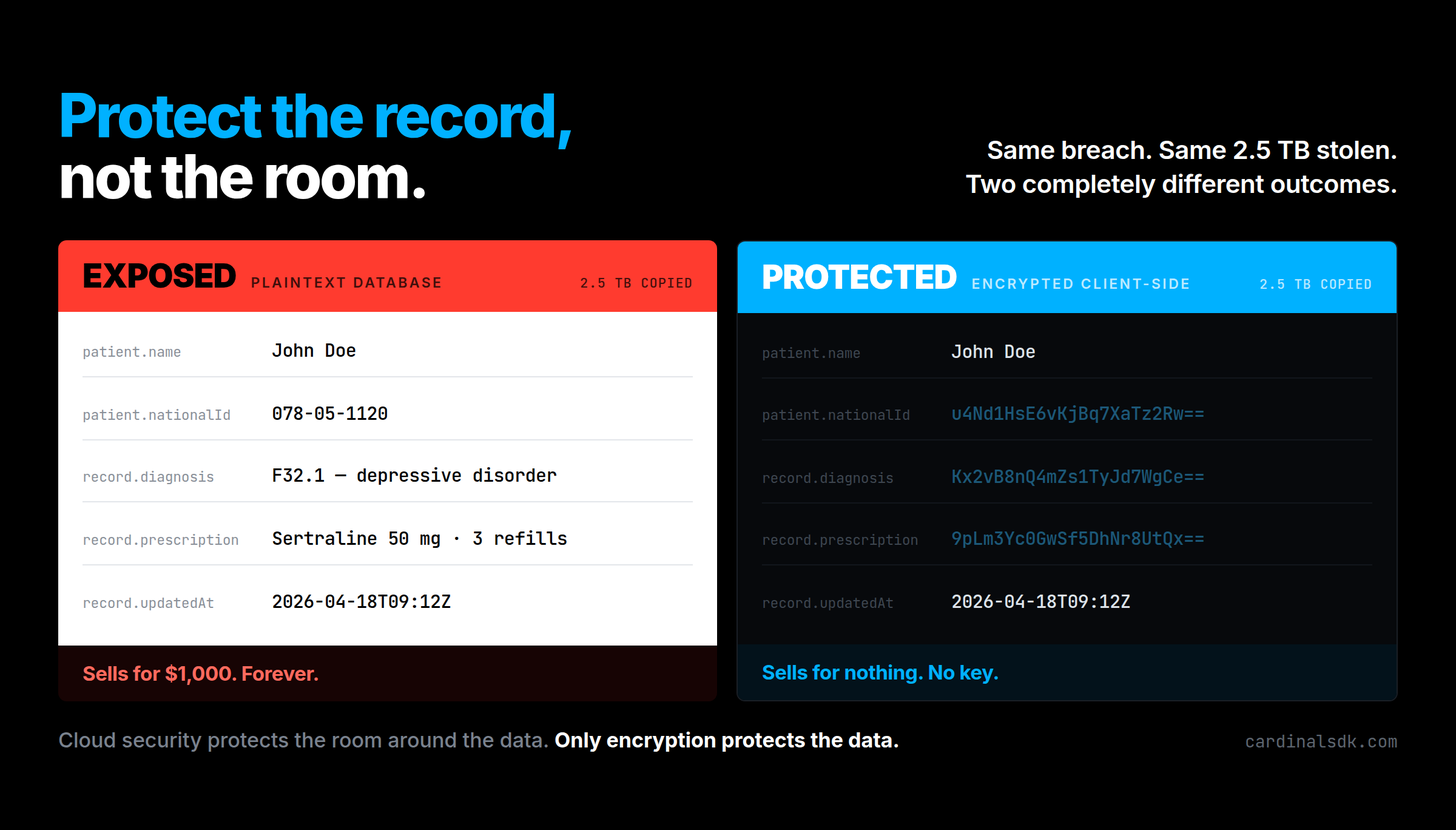
Cloud infrastructure security protects the environment around the data. It does not protect the data itself. And in the cloud, attackers rarely break in; they log in. A stolen credential, a compromised integration, a service account with too many permissions, and suddenly everything the platform can read in plaintext, the attacker can read in plaintext, 2.5 terabytes at a time.
Infrastructure security has a binary failure mode. It works, until it doesn’t, and then it protects nothing.
In a cloud and AI world that pressure only grows. Your data now flows through dozens of managed services, external APIs, model providers and pipelines you do not fully control. “Inside our environment” has stopped being a meaningful security statement.
Data-centric security flips the model
Protect the record, not the room. Encrypt the data itself, client-side, before it ever reaches a server, so it stays protected wherever it travels: through your backend, your analytics stack, your vendor integrations, your LLM prompts. Then a stolen credential yields ciphertext, not headlines.
And here’s what makes this urgent right now
Building a health app has never been faster. Lovable, Claude Code and similar tools take you from idea to working product in days; Vercel and Netlify put it in front of real users in minutes. This is genuinely accelerating innovation in healthcare. Clinicians, startups and hospital teams who could never justify a full engineering department can now build the tools their patients actually need, and iterate on them in weeks instead of years. It also means far more health data is being collected by far more teams, far earlier, than ever before.
The velocity is on the build side. It is not on the security side. End-to-end encryption, key management, patient-scoped access control and healthcare interoperability are hard, slow, easy to get subtly wrong, and almost never what a small team ships in week one.
That’s the gap Cardinal closes, and it was designed to fit exactly this way of building. The Cardinal SDK drops straight into the stack you are already using: generate your app in Lovable or Claude Code, deploy it to Vercel or Netlify, and call Cardinal from the same TypeScript or React code. Encryption happens at the application level, client-side, before data is created or modified, and decryption only on retrieval. You decide what stays readable: keep only the minimal non-sensitive fields in clear so your application can still index, filter and query efficiently, and everything else is encrypted by default. The Cardinal backend then makes that encrypted database easy to manage, with role-based and federated access control, ISO 27001 certified operations, and a data model built specifically for health and patient-centric applications that is natively compatible with FHIR. Run it fully managed, or on your own infrastructure if you operate your own, with the data residency you need. Cardinal itself never holds the keys; only your users can decrypt their data. SDKs are available for TypeScript, React Native, Kotlin, Swift, Python, Flutter, Java and more.
You get the speed of the new tooling with the data protection that patient records demand.
Ship fast. Just don’t ship the next breach of this scale.
Source on the MyDr breach: Cybernews
